AI Adoption in Off-Highway: Moving from Pilot Projects to Scalable Deployment
In the off-highway sector, AI models are improving fast. Deployment challenges are not.
Artificial intelligence started transforming the off-highway industry, driving efficiency, safety, and automation in equipment such as autonomous agricultural and mining vehicles. However, despite increased investment and successful pilot programs, many organizations never move past the proof-of-concept stage.
The problem is rarely the AI model itself.
Most failures, according to the Edge AI Survey, result from underestimating the model lifecycle challenges in real-world conditions. While pilot projects demonstrate technical feasibility, production deployment requires robust system architecture, appropriate hardware selection, and a comprehensive long-term deployment strategy
For companies pursuing machine autonomy, long-term ROI depends on the ability to transition from experimentation to scalable deployment.
The Pilot Issue in Off-Highway AI
Many industrial AI projects start with focused objectives, like obstacle detection, task automation, or enhanced operator awareness through computer vision. Early prototypes often perform well in controlled settings, building stakeholder confidence and momentum.
Then the deployment begins.
Unlike traditional IT environments, off-highway equipment operates in harsh, unpredictable conditions where reliability is non-negotiable. Optimal deployment proves that it can work consistently, safely, and economically across an entire fleet.
Controlled Environments Don’t Reflect Operational Reality
Pilot projects are frequently tested under ideal conditions. In production environments, however, off-highway equipment faces constant variability:
- Changing terrain and visibility
- Challenging illumination (glare)
- Seasonal conditions (rain and fog)
- Limited connectivity
- Long operational hours without interruption
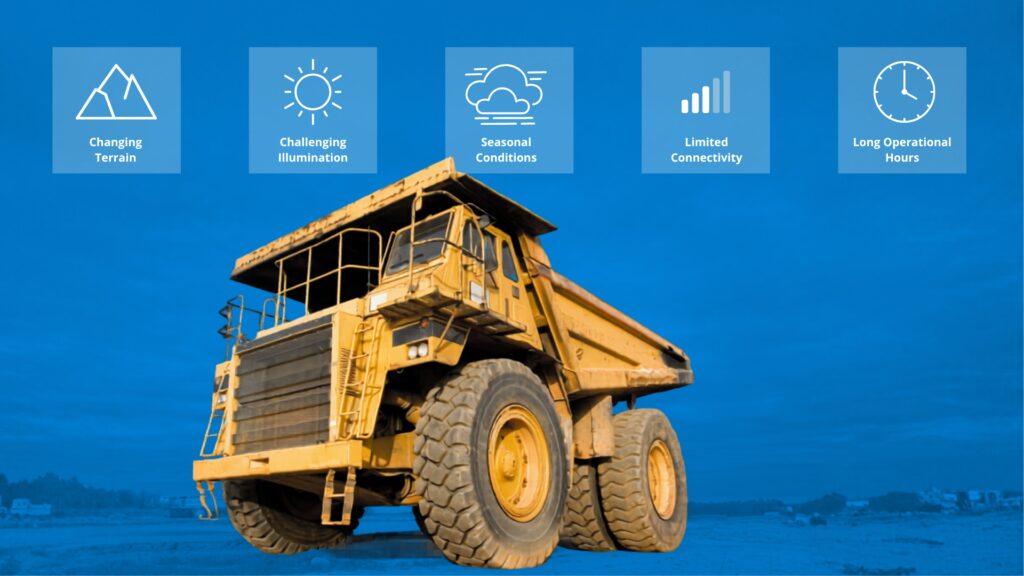
AI systems that are not designed for these operational realities quickly expose their limitations when deployed in the field.
Fragmented AI Deployment Strategy
Another common issue is the lack of a long-term deployment roadmap. Many organizations approach AI as an isolated R&D effort rather than an operational transformation initiative. As a result:
- Hardware decisions are made too early without scalability planning
- Data pipelines are incomplete
- Integration requirements are underestimated
- Maintenance and update strategies are ignored
The lack of a cohesive deployment strategy prevents AI projects from scaling and they often become expensive and difficult to develop further.
Hardware Choices Become Bottlenecks
Prototypes often use development hardware optimized for speed and experimentation, which may not withstand industrial operating conditions.
Why Edge AI Is Important in Off-Highway
Many industrial applications cannot rely only on cloud-based processing because off-highway environments often lack reliable, low-latency connectivity. Machinery that operates in remote mining sites, agricultural fields, or construction zones must use edge computing to process data and make decisions locally, in real time, without depending on continuous network access.
With data processed directly on the machine, edge systems enable:
- Faster decision-making
- Reduced latency
- Enhanced security
- Lower bandwidth dependency
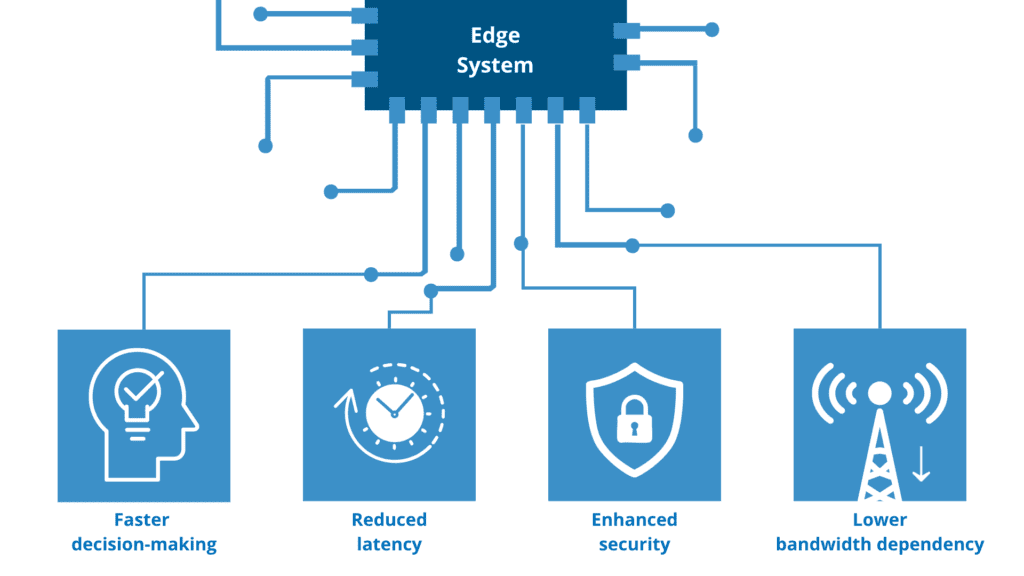
Edge processing enables equipment to respond instantly to changing environments and maintain operational continuity.
Architecture Planning Determines Scalability
One common mistake is treating AI deployment as a model-integration issue rather than a system-architecture challenge.
Scalable deployment starts with effective architecture planning.
Designing for Modularity
Production-ready AI systems must accommodate future changes in sensor configurations, compute requirements, and software capabilities. Modular AI system architecture enables companies to upgrade components incrementally or expand capabilities without full redesigns.
Without modularity, scaling AI typically leads to costly re-engineering.
Sensor Fusion Improves Reliability
Because off-highway environments are unpredictable, sensor fusion is central to modern embedded AI systems.
Combining multiple sensor modalities, such as cameras, LiDAR, radar, GNSS, and inertial systems, improves environmental understanding and operational reliability. For example:
- Cameras provide rich visual context
- Radar performs reliably in poor visibility
- LiDAR improves spatial awareness
- GNSS supports positioning accuracy
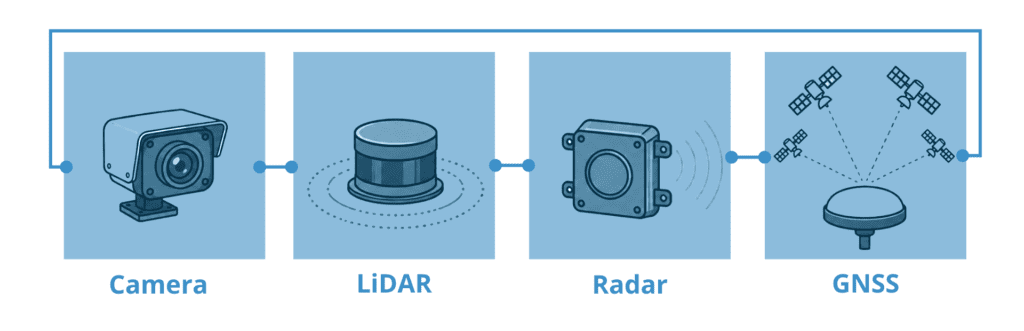
No single sensor is sufficient in all conditions. Robust machine autonomy relies on intelligent integration of multiple data sources.
Embedded Vision Systems Need End-to-End Planning
Many companies focus mainly on AI models, but often overlook how complex embedded vision systems really are. To make these systems function in the real world, several parts need to work together closely:
- Sensor hardware
- Processors that execute algorithms which analyze the sensor input
- Software frameworks
Planning these components independently significantly increases deployment complexity.
Hardware Selection as a Strategic Decision
As mentioned, hardware decisions made during early prototyping often determine the success of the entire project.
Consumer-Grade Platforms Don’t Always Survive Industrial Conditions
Development kits and non-industrial compute platforms accelerate experimentation but are sometimes not suitable for production deployment in off-highway environments.
Industrial deployments require systems engineered for environmental durability, extended operational lifecycles, and long-term component availability.
Without these features, maintenance costs and downtime rise quickly as systems scale.
Performance Must Align with Operational Requirements
Overpowered hardware increases system cost and energy use, while underpowered hardware leads to latency and reliability problems.
The goal is not maximum compute power but a balanced system design.
Successful deployments align hardware capabilities with other factors, such as sensor throughput, environmental constraints, and future scalability needs.
Deployment Strategy Is the Missing Link
Even with strong architecture and hardware choices, projects can fail without a scalable deployment strategy.
Scaling Requires Repeatability
Transitioning from AI off-highway pilot to production requires moving from isolated installations to repeatable deployment pipelines. In other words, it needs effective ML operations, or MLOps.
Organizations need this approach to process data, develop and maintain reliable models, automate data and model pipelines, scale deployment and retraining workflows, and continuously monitor system performance and business outcomes.
AI Systems Must Continuously Evolve
Industrial environments change constantly, and incorporating a feedback cycle into their architecture secures sustainable competitive advantages.
Production deployment requires continuous improvement loops:
- Collect operational data
- Identify edge cases
- Retrain models
- Redeploy optimized systems
Moving from Experimentation to Industrialization
As machine autonomy grows in importance across agriculture, mining, construction, and industrial mobility, companies must shift from short-term experimentation to long-term operational readiness.
That shift requires:
- Scalable system architecture
- Intelligent hardware selection
- Robust sensor fusion strategies
- Production-ready embedded vision systems
- Repeatable deployment processes
Building Scalable AI Systems for Off-Highway Projects
Creating AI systems for off-highway equipment requires more than model development. It demands coordinated expertise in architecture planning, embedded systems, deployment strategy, and industrial operations.
For organizations navigating this transition, our team supports the development of scalable systems tailored to off-highway environments. Connect with us to explore more.