What ISO/PAS 8800 Means for AI Safety in Autonomous Industrial Vehicles
In December 2024, ISO published ISO/PAS 8800, the first international specification focused on the safety of AI in road vehicles. It introduces guidance for challenges that are specific to AI, including data quality, model uncertainty, and continuous validation.
The publication reflects a broader move in how AI safety is approached. Autonomous industrial vehicles are becoming increasingly capable, with perception systems that can identify workers, classify equipment, navigate complex environments, and react to changing conditions in real time. Many of these capabilities rely on AI rather than traditional rule-based software.
Unlike conventional software, AI systems learn behavior from data. Their performance depends not only on the model itself, but also on the quality of training data, validation methods, operational conditions, and system integration. This makes AI more difficult to evaluate using traditional engineering methods alone.
As autonomous forklifts, mining vehicles, agricultural machinery, and construction equipment become more capable, manufacturers need new ways to demonstrate that these systems can operate safely under real-world conditions. Although ISO/PAS 8800 was developed for safety-related road vehicle systems, its engineering principles are increasingly relevant for autonomous industrial vehicles that rely on AI for perception and decision-making.
Why Traditional Functional Safety Is Only Part of the Picture
Imagine an autonomous wheel loader approaching a construction zone. The cameras, LiDAR, and processors all work exactly as intended.
However, the perception system mistakes a pile of construction material for part of the ground because similar examples were missing from the training data.
Nothing failed. Yet the machine still makes an unsafe decision. This is exactly the type of problem that becomes increasingly important as AI takes over perception and decision-support functions.
How Is ISO/PAS 8800 Different from FuSa and SOTIF
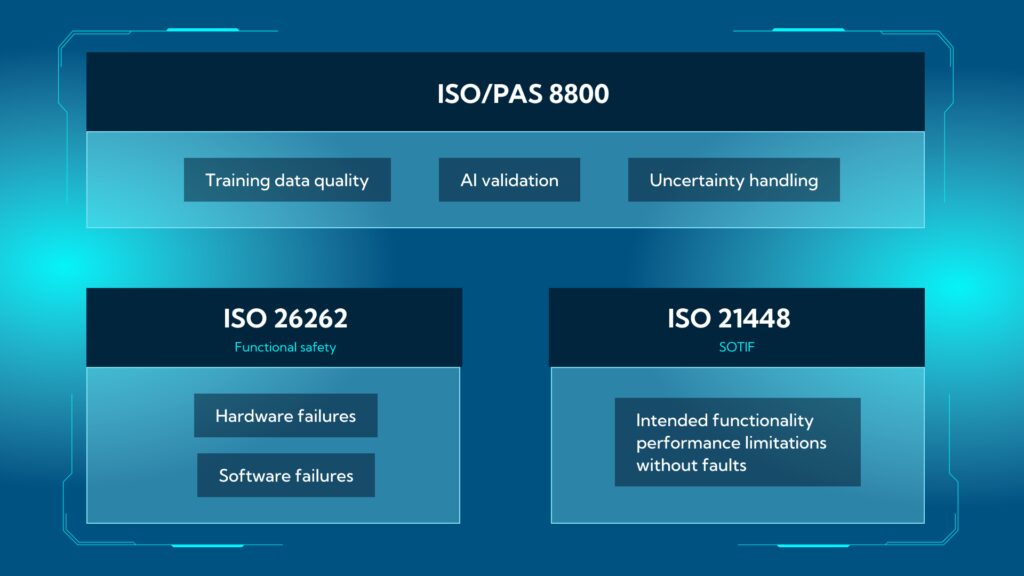
ISO/PAS 8800 does not replace existing automotive safety standards. Instead, it complements them by addressing safety challenges introduced by AI.
Each framework focuses on a different aspect of system safety.
ISO 26262, the foundation of Functional Safety (FuSa), addresses hazards caused by failures in electrical and electronic systems. It defines processes for identifying faults, assessing their impact, and ensuring systems can transition to a safe state if failures occur. If a steering controller fails or a sensor stops responding, functional safety defines how the system should detect the fault and transition into a safe state.
ISO 21448, known as Safety of the Intended Functionality (SOTIF), focuses on situations where a system functions as designed but still behaves unsafely because of limitations in perception, sensing, or decision-making. Instead of hardware failures, it focuses on situations where every component functions correctly, but the system still behaves unsafely because of limitations in perception or decision making.
ISO/PAS 8800 builds on these foundations by introducing guidance for AI-enabled systems. It addresses challenges that are unique to AI, including the quality and representativeness of training data, uncertainty in model behavior, limited explainability, and the possibility that a model will encounter scenarios that were not sufficiently represented during development.
Together, these standards provide a more complete safety framework for autonomous vehicles and industrial machines. While Functional Safety focuses on system failures and SOTIF addresses performance limitations, ISO/PAS 8800 extends safety engineering to include the continuous validation of AI behavior and structured assurance that AI systems can operate reliably in their intended operational environment.
AI Introduces Risks That Engineers Cannot Ignore
Unlike conventional software, AI models are statistical systems. Their performance depends on the information used during development.
A perception model trained primarily in clear daylight may perform differently during rain, dust, fog, or low-angle sunlight. Similarly, a detection model trained on standard pallets may struggle with damaged pallets, irregular cargo, or unfamiliar equipment. These are not software bugs. They are limitations of learned behavior.
ISO/PAS 8800 recognizes that these limitations must be understood, documented, and managed throughout development rather than discovered after deployment.
For engineering teams, this changes the conversation from “Does the model achieve high accuracy?” to “Do we understand where the model performs reliably, and where it does not?”
Data Is Part of the Safety Case
One of the most important ideas introduced by ISO/PAS 8800 specification is that datasets themselves become engineering artifacts. In other words, the framework ISO/PAS treats datasets as safety-relevant development work products that require engineering discipline throughout the AI lifecycle.
For traditional software, source code represents the primary deliverable.
For AI systems, the training, validation, and testing datasets are equally important because they directly influence system behavior. Those datasets must represent the operational environment the system will encounter in real-world conditions.
In practice, this means the datasets should capture the conditions the system will encounter after deployment. An autonomous warehouse vehicle should be trained and validated using different warehouse layouts, shelving configurations, reflective surfaces, and varying levels of pedestrian traffic. Agricultural machinery should account for different crops, weather conditions, soil types, and seasonal changes, while mining vehicles should include scenarios involving dust, uneven terrain, changing illumination, and partially obscured obstacles.
Collecting large amounts of data alone is not enough.
The important question becomes whether the data represents the operational environment accurately.
This is one reason why feasibility assessment and structured data collection are becoming increasingly important during early project phases.
Validation Becomes a Continuous Engineering Activity
One of the biggest misconceptions about AI is that validation ends once a model reaches a desired benchmark score.
Real-world deployment works differently.
An object detector achieving 98% accuracy may still miss exactly the type of object that creates the highest operational risk.
Instead of focusing only on benchmark performance, ISO/PAS 8800 provides guidance for organizations to understand model behavior across expected and unexpected situations.
Some of the examples include:
- sensor contamination from mud or dust
- temporary camera glare
- heavy rain
- partially hidden workers
- unusual equipment attachments
- damaged infrastructure
- unfamiliar objects
Testing these situations helps engineers understand system limitations before deployment.
More importantly, it allows organizations to design mitigation strategies instead of assuming the model will always perform perfectly.
Safety Requires More Than Good Test Results
Validation alone is not enough. A safe AI system requires objective evidence demonstrating that it can operate reliably within its intended environment.
ISO/PAS 8800 emphasizes building a structured assurance case that combines safety requirements, representative datasets, validation results, identified limitations, and mitigation measures into a coherent body of evidence. Rather than relying on a single performance metric, confidence comes from demonstrating that the system has been evaluated systematically and that known risks have been identified, understood, and appropriately managed throughout its lifecycle.
AI Cannot Be Evaluated Separately from the Rest of the Vehicle
One lesson that repeatedly appears in autonomous systems is that failures rarely originate from a single component. Instead, they emerge from interactions between multiple systems.
An excellent perception model cannot compensate for:
- poor camera calibration
- inaccurate sensor synchronization
- delayed processing
- inconsistent sensor fusion
- unreliable localization
This is why AI safety extends beyond the AI model itself. Confidence comes from the complete perception pipeline within the data pipeline.
From data collection and preprocessing to sensor fusion, inference, planning, and vehicle control, every stage contributes to overall system behavior.
The strongest AI models can still produce poor results if the surrounding system is not engineered with equal care.
Deployment Does Not End the Engineering Process
Unlike conventional software, AI systems continue to generate valuable engineering information after deployment.
Operational data reveals scenarios that may never have appeared during development. Construction sites evolve. Warehouse layouts change. Weather introduces new environmental conditions. Operators use equipment in unexpected ways.
Organizations that capture and analyze these observations can continuously improve both datasets and future model versions.
This iterative approach aligns closely with ISO/PAS 8800, which views AI safety as an ongoing engineering process rather than a one-time verification exercise.
What This Means for Companies Developing Autonomous Industrial Vehicles
Although ISO/PAS 8800 formally applies to road vehicles, many of its engineering principles are highly relevant for autonomous industrial vehicles that rely on AI perception.
Any organization building autonomous industrial vehicles faces similar questions:
- Does the training data represent real operating conditions?
- Are model limitations understood?
- Can engineers explain why the system behaves as expected?
- Is validation systematic and repeatable?
- Can deployment decisions be supported with objective evidence?
Answering these questions builds confidence long before certification or regulatory requirements become part of the discussion.
For companies developing computer vision and AI systems, this means moving beyond model accuracy as the primary success metric.
Instead, success comes from combining structured validation, representative datasets, robust perception systems, and continuous evaluation under real-world conditions. That is ultimately the direction ISO/PAS 8800 points the industry toward.
Rather than introducing an entirely new concept of safety, it extends existing engineering practices to reflect how modern AI systems are actually developed and deployed.
As autonomous industrial vehicles continue to become more capable, these engineering principles are likely to become just as important as Functional Safety and SOTIF are today.